Thursday, September 01, 2011

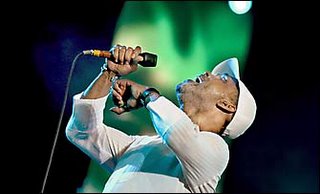
Frankie Beverly & Maze

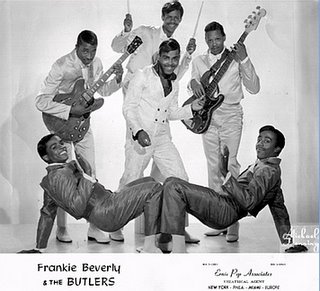
Frankie Beverly is one of those cats that has lasting power. He started in the music business doing a tour with doo wop group the Silhouettes and then formed his own group called the Blenders. The Blenders never recorded a single, Beverly wouldn't appear on wax until forming the Butlers a few years later. Along with Beverly, the Butlers included Jack "Sonny" Nicholson, Joe Collins, John Fitch, and Talmadge Conway.

Beverly would later enjoy great success fronting Maze and
Conway would become a well-known songwriter
penning Double Exposure's "Ten Percent" and the Intruders' "Memories Are Here To Stay."
While Maze is a phenomenal group, Beverly's work before that group will always stand out as his best (imo). The Butlers produced tunes that most Northern Soul fans would kill for and Raw Soul gave the funksters something to pursue. If, by chance, you know of a way to get in touch with Frankie Beverly or his management, please drop me an e-mail. It would be absolutely great to do an interview with him about his pre-Maze work. He's still playing out, most recently doing a New Year's Eve show in Atlanta. You can find current tour dates for Maze. The history of the Butlers/Raw Soul is dense, but for all of us music nerds, that's normal. It is not totally clear what year the Butlers actually formed but they released their first single in 1963 on Liberty Records. That single was "She Tried To Kiss Me" and another single followed on Guyden entitled "Lovable Girl." After the Guyden single the Butlers took a break not recording another record until the single "Laugh, Laugh, Laugh" was released on the Phila label in 1966. The group also backed Charles Earland and Jean Wells on one Phila single ("I Know She Loves Me").


As you might be noticing, the Butlers were doing a fair amount of recording but not achieving much success. The group's recordings sold regionally but never had the promotion to make an impact on the national scene. After the single with Phila, the Butlers moved to the Fairmount label (part of the Cameo-Parkway family) and released a handful of singles, some being reissued singles of the past. The Butlers were with Fairmount for 1966-67 and then moved to Sassy Records. Sassy released the group's greatest single (in my opinion) "Love (Your Pain Goes Deep)" b/w "If That's What You Wanted." A copy of that 45 sold for just under $500 last summer on eBay. Even though that isn't that much in the world of record collecting--it's still a hefty sum. The Butlers released another single on Sassy ("She's Gone" b/w "Love Is Good") that appears to be even harder to come by then the
"Love (Your Pain Goes Deep)" single.


The true history become a bit blurred here as the AMG biography states that the Butlers last record was released on C.R.S. in 1974 (". However, between 1971 and that single, Frankie Beverly formed a group called Raw Soul and released a number of singles. Some of the songs recorded by Beverly during this period are "While I'm Alone," "Open Up Your Heart," (both on the Gregor label) and "Color Blind." "Color Blind" was released by the Eldorado label and rerecorded by Maze. Beverly's big break came when Marvin Gaye asked Raw Soul to back him on a tour.

Gaye helped Beverly/Raw Soul get a contract at Capitol. Beverly decided to take the group in a different direction, a name change occurred, and Maze was created. The above isn't the most complete history of Beverly but hopefully someone will know a way to get in touch with the man or his management because a comprehensive pre-Maze history needs to be done on Frankie Beverly (his real name is Howard, by the way). Below you'll find every Frankie Beverly (pre-Maze) song available to me right now ("Color Blind" will be up soon). If you have a song that is not included below, shoot it over to funkinsoulman (at) yahoo.com and it will go up in the next Frankie Beverly post (later this week--highlighting Maze). Also, if you have any more information please share your knowledge. The Butlers material has been comp-ed sporadically (usually imports) but the entire Maze catalog has been reissued and is available. Enjoy.
"She Kissed Me"
(Fairmount, 1966 or 1967)

"I Want To Feel I'm Wanted"
(not sure which label or year)
"Laugh, Laugh, Laugh"
(Phila, 1966)
"Because Of My Heart"
(Fairmount, 1966 or 1967)

"Love (Your Pain Goes Deep)"
(Sassy, 1967)
"If That's What You Wanted"
(Sassy, 1967)

"While I'm Alone"
(Gregor, 1971)

  1. play Maze — 01 Feel That You're Feelin'
  2. play Maze — 02 Somebody Else's Arms
  3. play Maze — 03 Southern Girl
  4. play Maze — 04 Can't Get Over You
  5. play Maze — 05 Golden Time Of Day
  6. play Maze — 06 Never Let You Down

Wednesday, August 31, 2011

K2K2 FM-88.9

Simply put..the BEST Music Streamin..
Live from the transmitters of edie2k2, 24/7 365+

Wednesday, August 24, 2011

Weary Blues By Langston Hughes

The Weary Blues
by Langston Hughes

Droning a drowsy syncopated tune,
Rocking back and forth to a mellow croon,
I heard a Negro play.
Down on Lenox Avenue the other night
By the pale dull pallor of an old gas light
He did a lazy sway . . .
To the tune o' those Weary Blues.
With his ebony hands on each ivory key
He made that poor piano moan with melody.
O Blues!
Swaying to and fro on his rickety stool
He played that sad raggy tune like a musical fool.
Sweet Blues!
Coming from a black man's soul.
O Blues!
In a deep song voice with a melancholy tone
I heard that Negro sing, that old piano moan--
"Ain't got nobody in all this world,
Ain't got nobody but ma self.
I's gwine to quit ma frownin'
And put ma troubles on the shelf."

Thump, thump, thump, went his foot on the floor.
He played a few chords then he sang some more--
"I got the Weary Blues
And I can't be satisfied.
Got the Weary Blues
And can't be satisfied--
I ain't happy no mo'
And I wish that I had died."
And far into the night he crooned that tune.
The stars went out and so did the moon.
The singer stopped playing and went to bed
While the Weary Blues echoed through his head.
He slept like a rock or a man that's dead.

©1994 the Estate of Langston Hughes


Wednesday, August 17, 2011

The Blues Lounge...♪♫♪

Click To Play:

The origins of blues is not unlike the origins of life. For many years it was recorded only by memory, and relayed only live, and in person. The Blues were born in the North Mississippi Delta following the Civil War. Influenced by African roots, field hollers, ballads, church music and rhythmic dance tunes called jump-ups evolved into a music for a singer who would engage in call-and-response with his guitar. He would sing a line, and the guitar would answer.

From the crossroads of Highways 61 and 49, and the platform of the Clarksdale Railway Station, the blues headed north to Beale Street in Memphis. The blues have strongly influenced almost all popular music including jazz, country, and rock and roll and continues to help shape music worldwide.
The Blues... it's 12-bar, bent-note melody is the anthem of a race, bonding itself together with cries of shared self victimization. Bad luck and trouble are always present in the Blues, and always the result of others, pressing upon unfortunate and down trodden poor souls, yearning to be free from life's' troubles. Relentless rhythms repeat the chants of sorrow and pity of lost souls.

This is the Blues.

W.C. Handy
The blues form was first popularized about 1911-14 by the black composer W.C. Handy (1873-1958). However, the poetic and musical form of the blues first crystallized around 1910 and gained popularity through the publication of Handy's "Memphis Blues" (1912) and "St. Louis Blues" (1914). Instrumental blues had been recorded as early as 1913. During the twenties, the blues became a national craze. Mamie Smith recorded the first vocal blues song, 'Crazy Blues' in 1920. The Blues influence on jazz brought it into the mainstream and made possible the records of blues singers like Bessie Smith and later, in the thirties, Billie Holiday.
The Blues are the essence of the African American laborer, whose spirit is wed to these songs, reflecting his inner soul to all who will listen. Rhythm and Blues, is the cornerstone of all forms of African American music. Many of Memphis' best Blues artists left the city at the time, when Mayor "Boss" Crump shut down Beale Street to stop the prostitution, gambling, and cocaine trades, effectively eliminating the musicians, and entertainers' jobs, as these businesses closed their doors. The Blues migrated to Chicago, where it became electrified, and Detroit.
elmore2.jpg (13246 bytes)
Elmore James

In northern cities like Chicago and Detroit, during the later forties and early fifties, Muddy Waters, Willie Dixon, John Lee Hooker, Howlin' Wolf, and Elmore James among others, played what was basically Mississippi Delta blues, backed by bass, drums, piano and occasionally harmonica, and began scoring national hits with blues songs. At about the same time, T-Bone Walker in Houston and B.B. King in Memphis were pioneering a style of guitar playing that combined jazz technique with the blues tonality and repertoire.
bluesbb.jpg (114008 bytes)
B.B. King
Meanwhile, back in Memphis, B.B. King invented the concept of lead guitar, now standard in today's Rock bands. Bukka White (cousin to B.B. King), Leadbelly, and Son House, left Country Blues to create the sounds most of us think of today as traditional unamplified Blues.

bluescrudup.jpg (76960 bytes)
Arthur "Big Boy" Crudup
Arthur "Big Boy" Crudup, Wyonnie Harris, and Big Mama Thorton wrote and preformed the songs that would make a young Elvis Presley world renown. In the early nineteen-sixties, the urban bluesmen were "discovered" by young white American and European musicians. Many of these blues-based bands like the Paul Butterfield Blues Band, the Rolling Stones, the Yardbirds, John Mayall's Bluesbreakers, Cream, Canned Heat, and Fleetwood Mac, brought the blues to young white audiences, something the black blues artists had been unable to do in America except through the purloined white cross-over covers of black rhythm and blues songs. Since the sixties, rock has undergone several blues revivals. Some rock guitarists, such as Eric Clapton, Jimmy Page, Jimi Hendrix, and Eddie Van Halen have used the blues as a foundation for offshoot styles. While the originators like John Lee Hooker, Albert Collins and B.B. King--and their heirs Buddy Guy, Otis Rush, and later Eric Clapton and the late Roy Buchanan, among many others, continued to make fantastic music in the blues tradition. The latest generation of blues players like Robert Cray and the late Stevie Ray Vaughan, among others, as well as gracing the blues tradition with their incredible technicality, have drawn a new generation listeners to the blues.
W.C. Handy the Father of the Blues wasn't an ordinary Delta bluesman. Handy studied music as a youth, playing the cornet and traveling the South with dance bands playing minstrel and tent shows. Later in life he became a songwriter, bandleader and publisher.
bluescross.jpg (101142 bytes)
The Southern Cross' The Dog The intersection of the Southern Railroad and the Yazoo & Mississippi Valley Railroad (The Dog) at Moorhead, Mississippi that inspired the singer at Tutwiler.
Legend is that while waiting for an overdue train in Tutwiler, Mississippi, in 1903 that he heard an itinerant bluesman playing slide guitar and singing about "going' where the Southern cross the Dog," referring to the junction of the Southern and Yazoo and Mississippi Valley railroads farther south near Moorhead. Handy called it "the weirdest music I had ever heard."
bluescrossroads.jpg (136346 bytes)
The Crossroads
In the delta of the Mississippi River, where Robert Johnson was born.
bluesjohnson.jpg (110215 bytes)
Robert Johnson
Not much is known about Johnson other then after the death of his wife in 1930 he decided to become a bluesman. Wandering around the Delta in 1933, he met Son House and Willie Brown. When they heard him play on the guitar startled them. In an amazingly short time, Johnson had turned into a blues guitar master.
blueslemon.jpg (215999 bytes)
Blind Lemon Jefferson
Blind Lemon Jefferson was indeed blind, unlike other Delta musicians who merely claimed the limitation. He died penniless in Chicago in December 1929, possibly suffering a heart attack when he became disoriented during a snowstorm.
bluesleadbelly.jpg (293551 bytes)
Huddie William Ledbetter aka Lead Belly
Leadbelly was a large man, and given to fits of rage. In 1917, he was convicted in Texas for killing a man and in 1930 was convicted of attempted murder in Louisiana. Both sentences were commuted, however, based solely on his musicianship. His "discovery" came, in fact, at Louisiana's Angola Prison Farm.
Willie Dixon was certainly the single most important presence on the postwar Chicago scene. What distinguished Willie Dixon from most other Delta bluesmen of his day was his ability to read, write, compose, and arrange music -- talents that were to destine him for legendary status among the bluesmakers. However, it was boxing, not music, that brought Dixon to Chicago in 1936. He was an upstart professional fighter who for a time sparred with the great Joe Louis.
chesshowlin.jpg (4678 bytes)
Named after a 19th-century American president, young Chester Arthur Burnett earned the nickname that was to become synonymous with the power of his voice "Howlin' Wolf."
Thanks For Your Visit

Momma and Me at Uncle Ely's Impala Lounge..Chicago 1976

Thursday, March 06, 2008

Remembering Phyllis Hyman

DIVA. A reference made to a female performer (usually an opera singer). In the popular vernacular of the music business, particularly in black music circles, the term diva takes on a whole other meaning. It implies that a female artist is demanding, difficult, uncompromising, inflexible. It can also be considered a term of endearment, referring to the incredible talent they possess, making them a cut above the rest. In addition to these 'Diva Qualities', Phyllis was also very elegant, statuesque, radiant, photogenic, and jazzy. Phyllis Hyman was truly a SOPHISTICATED LADY!!

With so much media attention focused on current would-be's, wanna-be's and has been's, it's rare to find any pertinent coverage of the women who make up the backbone of today's R&B, Pop and Jazz fields. Mariah Carey, Whitney Houston, Toni Braxton, and a host of girl groups owe a tip of the hat to their predecessors, women who didn't glide so easily to the top of the charts, or at least with such frequency.

Phyllis Hyman, Jean Carne, Marlena Shaw, Melba Moore, Chaka Khan, and Angela Bofill have all been recording for many years as underappreciated Divas. Unlike Houston, Carey, and Braxton however, these women's careers have progressed like quiet thunder, providing them with regular touring work (while also fighting brutal & unfair record companies), and also being constantly in demand as guest vocalists on a variety of albums/CDs.

Devoted fans of the late singer Phyllis Hyman describe her as a songstress extraordinaire with a no-nonsense attitude, and a lavish, larger than life stage persona. Deep-voiced and statuesque, Phyllis sang with a life affirming energy and emotional intensity found in few other female vocalists. Born in Pittsburgh in 1949 (and raised in Philadelphia), her professional career began in New York city where, during an engagement, she was spotted by producer Norman Connors and contemporaries Jean Carne and Roberta Flack among others. Phyllis was immediately offered a guest appearance on Connors' 'You Are My Starship' album (1976), which included her classic rendition of 'Betcha By Golly Wow' (previously a hit for The Stylistics in the early 1970's).
In 1977 Buddah Records released her self-titled debut LP which featured the hits 'Loving You/Losing You' and 'I Don't Wanna Lose You'.

A year later Hyman was signed to Arista Records. Her premiere album for the label 'Somewhere In My Lifetime', was released in 1978 ('Somewhere In My Lifetime' included many tracks that Phyllis recorded for a 2nd album at Buddah titled 'Sing A Song', which is now available on CD!). The title track for 'Somewhere..' (produced by then newcomer Barry Manilow, a longtime admirer of Hyman's) became Phyllis' first solo radio hit. A cover version of Exile's 'Kiss you All Over' was remixed for club play as part of Arista's promotion, showcasing her versatility. The following year, the James Mtume/Reggie Lucas produced 'You Know How To Love Me' (1979, Arista) album hit the record stores, and the title track became one of Hyman's biggest hits. The 1979 album became a then best seller for Phyllis, even though Clive Davis wasn't enthusiastic with the finished project. She would include the hit title track it in her repertoire until the time of her passing. The album, which also contained fan favorites like 'Complete Me' & 'Under Your Spell', was remastered & re-released in 2002 with informative liner notes & comments by producer James Mtume. The remastered CD also featured a rare unreleased 1977 track ('You're The One').

In addition to having a hit album in 1979, Phyllis also lent her talents to the original soundtrack for 'The Fish That Saved Pittsburgh' (starring Julius 'Dr.J.' Erving!), which was a minor hit despite being slayed by most critics, but it was a lot of fun for basketball fans. Phyllis sang 'Magic Mona', which was the theme song for one of the central characters played by Stockard Channing.
In 1981 Phyllis co-starred (with Gregory Hines & Judith Jamison) in the hit Broadway tribute to Duke Ellington, 'Sophisticated Ladies' and continued in the role for two and a half years, garnering a Tony Award nomination and a Theatre World Award for Best newcomer. The original cast recording was released by RCA and the CD is now out of print. While performing in Ladies, Phyllis cut her next album, 'Can't We Fall In Love Again' (1981) featuring the title track (a duet with Michael Henderson), and production by Norman Connors. Phyllis was at the peak of her career at this point, and was widely recognized as a New York celebrity. She was everywhere!

The follow up album, 'Goddess Of Love' (1983) featured a sensational cover shot of Hyman at her most seductive, draped in a silver bugle beaded gown (which, according to Phyllis, weighed thirty pounds!) and sporting chandelier-sized earrings, a Hyman trademark. The album (produced by Narada Michael Walden & Thom Bell), although containing two strong tracks, was considered patchy at best and Phyllis, discontented with the material chosen for this project was blunt about her feelings toward Arista records and its cavalier attitude towards her."Firstly, I came to the label because of the takeover of Buddah. So I didn't have much choice in the matter," she recalled. "There were some nice records, but I'd say I was pretty much overlooked and ignored."Ironically, the title 'Goddess of Love' stuck with Phyllis as a term of endearment from both critics and fans. 'Goddess' would be Hyman's final Arista album, and even though it is a highly sought collector's item, Arista never released it on CD, and all of the songs are scattered on a variety of Phyllis compilations released by Arista /BMG.

Phyllis was left unrecorded for four years due to contractual discrepancies with Arista, and since she was still 'legally' bound to the Clive Davis-operated company, signing with another label wasn't possible. Arista records also tried to destroy Hyman's career by deleting key albums/CDs, and also by preventing her from recording full legth albums elsewhere. During Phyllis' tenure as a prisoner at Arista, the label used all of it's resources to promote Dionne Warwick, Aretha Franklin & Whitney Houston's self-titled debut album in 1985 (Angela Bofill was barely holding on at the label herself at this time). While legal battles ensued, Phyllis appeared on numerous movie soundtracks & albums as a guest vocalist, most notably with Chuck Mangione, Barry Manilow, The Whispers, and The Four Tops.

Keeping in the public eye, Phyllis also toured extensively with her band, did a college lecture tour, and lent her voice to several television commercials.
In mid 1985, Phyllis was finally FREE from Arista, and in 1986, she recorded the classic 'Living All Alone' album for the resurgent Philadelphia International record label (released through Manhattan/EMI and produced by Kenny Gamble and Leon Huff). The release of the first single, 'Old Friend', brought Hyman back to the forefront of the industry with saturated radio play, international concert bookings, talk show appearances and countless magazine articles. Arista also attempted to cash in on the new success that Phyllis was enjoying by releasing the shabby 'Under Your Spell' compilation, which totally missed the mark. Phyllis also had a cameo role in the Spike Lee film, 'School Daze' (1988), performing the jazzy tune 'Be One', to which a video was later released. Other film appearances include 'Lenny' (1976), 'Two Scared To Scream' (1983) and a co-starring role with Fred Williamson in the action drama 'The Kill Reflex' (1991).

'Prime of My Life' (1991, P.I.R./Zoo/BMG) was Phyllis' eagerly awaited follow up album after a four year lull, but was well worth the wait as she took an active role in selecting the material. While making the album, she agonized over a recent breakup. "It made the songs difficult to record, but the results were fabulous," Phyllis conceded. The uptempo hit song, 'Don't Wanna Change The World', was enthusiastically received by clubs and radio, attaining international status and becoming her FIRST number one record according to Billboard. When the song's popularity soared, P.I.R./Zoo issued a remixed version to accommodate the demands of disk jockeys around the country.

In 1992 Phyllis was voted 'Number One Best Female Vocalist' in the United Kingdom by Blues & Soul magazine readers, beating out the likes of Anita Baker, Whitney Houston and Aretha Franklin. During this time Phyllis became involved in combating the AIDS crisis by lending her voice to countless benefit shows and visiting wards and hospices in and around New York. Many patients requested Phyllis' presence, which left the singer feeling inadequate and perplexed as to their reasons for wanting to see her as opposed to a family member or friends. The visits took a heavier toll on Phyllis that she realized. By now, her own personal problems were becoming evident. An ongoing battle with alcohol and weight gain, combined with career and financial woes were making life difficult for Hyman and those around her. In 1993 she was dealt another blow when both her mother and grandmother died within a month of one another.

Although Phyllis continued to record new material and perform live, her bouts of depression were clearly overwhelming her. Her irrational, self-destructive behavior was becoming common knowledge to those inside the music industry, her friends and also her fans and on June 30th, 1995, only hours before a scheduled performance (opening for The Whispers) at the Apollo Theatre in New York, Phyllis' lifeless body was found in her apartment where all efforts to revive her failed. Her suicide, while shocking, was not a surprise to many insiders. We, like so many others who know her, believed she would pull her life together. Sadly, we were mistaken.

In the posthumous released, 'I Refuse To Be Lonely' (1995, P.I.R./Zoo/BMG), Phyllis alluded to her inner struggle on several songs, five of which she co-wrote. Her most intimate and emotional project yet, 'I Refuse To Be Lonely' had reached the top 15 on Billboard's R&B chart, proving that talent of this caliber will always stand the test of time. Three years later, 'Forever With You' (1998, P.I.R./BMG), was released with the title being chosen by Hyman's loyal fans. 'Forever With You' is an awesome collection of unreleased songs that Phyllis recorded for Philadelphia International Records between 1986 and 1995, and it conveys the rich emotions that we have all come to associate with Hyman.

Most recently in 2003, Michael Grimaldi spearheaded the release of a special Phyllis Hyman compilation. The CD titled 'In Between The Heartaches-The Soul Of A Diva' (2003, Expansion Records), is being heralded as a classy tribute to the lost Diva, and it's packaging (liner notes, photos, etc.) is probably the best ever designed for a Hyman CD. The CD features many rare tracks including 3 with McCoy Tyner, 'Magic Mona', and a host of previously unreleased gems. While fans rejoice over Grimaldi's project, Arista/BMG continues to release redundant compilations for Phyllis including 'The Essence Of Phyllis Hyman' & 'The Ultimate Phyllis Hyman', which is nothing but a watered down version of 'The Legacy Of Phyllis Hyman'. All is not lost for Hyman's most devoted fans, as Grimaldi has revealed the existence of additional rare music, and future projects to honor The Sophisticated Lady's gift of song.

Phyllis Hyman's passing has left a void in the entertainment world, and in the hearts of many, including her most devoted fans. We wish that Phyllis knew how much she was loved & appreciated, and her legacy is a testimony to her tremendous gift of song. Phyllis Hyman will never be forgotten!